March 8, 2026
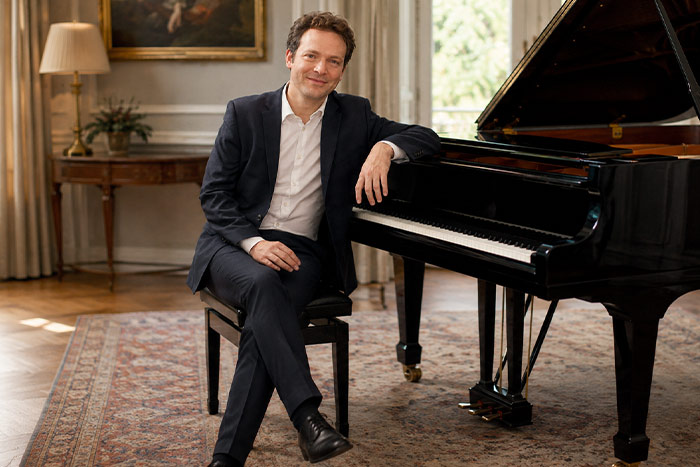
About the Author: Reuben

Few musicians have shaped the language of jazz piano as profoundly as Bill Evans.
Emerging in the late 1950s, Evans transformed the role of the jazz pianist through lyrical touch and emotional harmony, as well as having great influence with his collaborative approach to ensemble playing.
His influence extends far beyond his own recordings, and permeates modern jazz piano vocabulary, continuing to shape how pianists think about harmony, rhythm, and musical interaction.
He is also considered one of the most influential pianists in developing modern solo piano language.
For these reasons, every jazz pianist, regardless of style or experience, should study Bill Evans.
Harmony
One of the most compelling reasons to study Evans is his revolutionary approach to harmony.
Evans drew heavily from twentieth-century classical composers such as Claude Debussy and Maurice Ravel, incorporating impressionistic harmonies into jazz.
His use of quartal voicings, rootless chords, and extended harmonies allowed pianists to move beyond simple chord structures and explore richer sonic textures.
Evans demonstrated how subtle chord choices could dramatically transform the emotional color of a tune.
This was a crucial step in developing solo jazz piano beyond the restrictive world of stride piano, and towards the much more fluid approach we can hear today.
For a developing jazz pianist, studying this harmonic approach builds a deeper understanding of harmonic possibilities and voice leading.
Listen to his solo versions of “Like Someone in Love”, “Here’s That Rainy Day” and “When I Fall in Love” for my favourite examples of this harmonic delicacy.
Style
Equally important is Evans’s extraordinary sense of touch and tone.
Unlike many pianists of the bop era who favoured aggressive articulation, Evans cultivated a delicate, almost vocal approach to the piano.
His phrasing often resembled that of a singer, emphasising lyrical expression and dynamic nuance.
In fact, his up-tempo time feel was arguably too angular and lacking momentum, making his interpretations of ballads more sought-after for me.
Listening to performances such as “Waltz for Debby” or “My Foolish Heart” reveals how Evans used space and softness as expressive tools.
Delicate moments are treated with very carefully considered voicings, and often stand out purely in beauty and not in dynamic impact like earlier pianists may have done.
Pianists who study his recordings learn that jazz is not solely about technical virtuosity; it is also about sensitivity, control, and emotional depth.
Bandleading
Evans also reshaped the way jazz musicians interact within small ensembles.
His work with the Bill Evans Trio, particularly alongside bassist Scott LaFaro and drummer Paul Motian, pioneered a conversational style of group interplay.
Rather than relegating the rhythm section to a purely supportive role, Evans encouraged a democratic musical dialogue in which each instrument contributed equally to the improvisation.
This interactive approach became a defining feature of modern jazz ensembles.
By studying Evans’s trio recordings, pianists gain insight into listening, reacting, and collaborating creatively with other musicians.
Improvisation
Another essential aspect of Evans’s artistry is his melodic improvisation.
His solos often unfold like carefully composed pieces, with clear thematic development and logical structure.
Instead of relying solely on fast runs or gimmicks, Evans crafted improvisations that told a musical story.
He frequently developed motifs, revisited earlier ideas, and shaped his solos with a sense of architecture.
Like his song arrangements and interpretations, there is nothing flashy about his improvisation, and there is often a childlike simplicity to the ideas he uses.
For students of jazz piano, analysing Evans’s improvisations offers a masterclass in musical storytelling and thematic development.
Influence
Evans’s influence can also be heard in the work of countless jazz pianists who followed him.
Artists such as Herbie Hancock, Chick Corea, and Brad Mehldau have all acknowledged the impact of his harmonic language and lyrical sensibility.
By studying Evans, pianists gain direct access to a lineage of ideas that continue to shape contemporary jazz.
In many ways, Evans represents a bridge between bebop traditions and the modern improvisational vocabulary used today.
Listening to interviews with the above pianists is highly recommended, as Evans is guaranteed to receive a mention alongside many other crucial influences.

Philosophy
Finally, studying Bill Evans encourages musicians to approach jazz with curiosity and openness.
Evans himself was an avid learner who constantly explored new musical influences and philosophical ideas.
He believed deeply in the value of reflection, practice, and personal expression.
His famous interviews reveal a thoughtful musician who viewed improvisation not as a display of ego, but as a process of discovery.
The lack of ego and showmanship in his character is on full display in concert tapes, and is a useful reminder that the focus should be the music, not the player.
For aspiring pianists, this mindset is as valuable as any technical lesson.

Conclusion
Bill Evans remains one of the most important figures in jazz piano history.
His innovations in harmony, lyrical delivery, ensemble interaction, and melodic improvisation have left an enduring mark on the genre.
By studying his recordings, transcriptions and interviews, jazz pianists can develop a deeper understanding of the instrument and of jazz itself.
More than simply learning licks or voicings, studying Bill Evans teaches musicians how to listen, collaborate, and express themselves with nuance and authenticity.
For anyone serious about jazz piano, the study of Bill Evans is not just beneficial—it is essential.

RELATED POSTS