Piano Technique

Phrasing in Piano Playing and How to Beautifully Play the Two-Note Phrase

2025-10-27T12:23:23+00:00

Phrasing in piano sheet music is indicated by a long curving line over a group of notes. These notes normally form a melodic line that one can compare with a sentence you speak. For example, let's think about someone asking you a question and then you answer it. Maybe you are asked: ‘How are you doing today?’ The five words here will all be grouped under one phrase mark. Then the answer to the question would probably be something like: ‘I am very well today, thank you’ forming another phrase. Why Are There Phrases Marked in My Sheet Music? As in [...]

Phrasing in Piano Playing and How to Beautifully Play the Two-Note Phrase2025-10-27T12:23:23+00:00

How Rotation Immediately Changes Your Piano Playing

2025-09-24T16:26:26+01:00

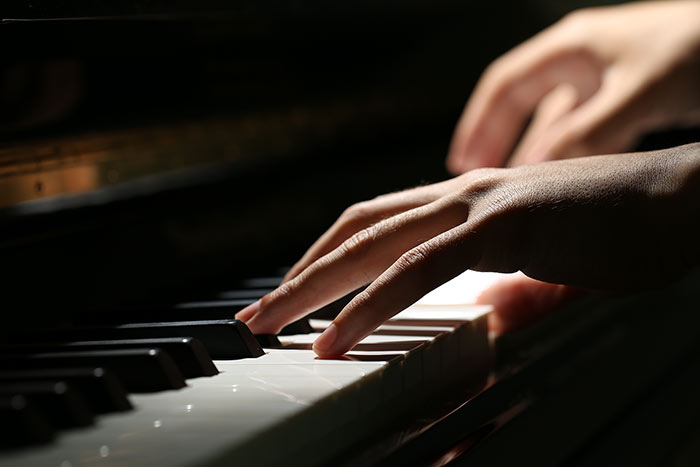
When pianists begin their training, much attention is usually placed on finger strength, scales, and the ability to move the hands independently. These skills are important, but they can never fully compensate for one essential movement that underpins healthy, expressive, and fluent piano playing: rotation. The act of rotating the forearm, even in the smallest degree, immediately alters tone, control, and ease at the keyboard. It is a technical principle that, once understood, can transform your entire approach from the very first attempt. This article explains why rotation is such a powerful concept in piano playing, how it functions anatomically, what [...]

How Rotation Immediately Changes Your Piano Playing2025-09-24T16:26:26+01:00

A Pianist’s Guide To Using The Pedal

2025-06-16T13:21:53+01:00

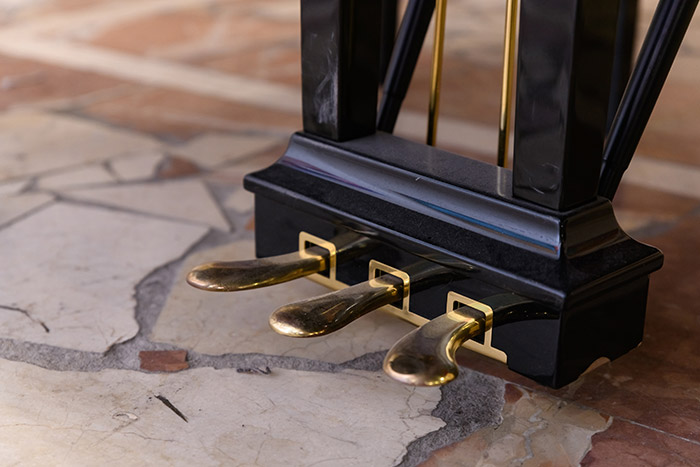
Looking to level up your piano playing? This guide is your short and sweet introduction to understanding piano pedals—what they do, how they work, and why they matter. What Are Piano Pedals? In a nutshell, the pedal is a foot-operated lever that alters the sound of the piano, making it possible for a greater expression and control that a pianist would not be able to achieve with hands alone. You would typically find three pedals on most pianos; the sustain pedal, soft pedal and middle pedal— each one serving a different purpose. Although, it is more common to see only two [...]

A Pianist’s Guide To Using The Pedal2025-06-16T13:21:53+01:00

The Circle of Fifths and How to Use It in Your Piano Practise

2025-05-13T16:31:22+01:00

The Circle of Fifths is one of the most powerful tools in music theory, and when applied to piano practise, it can sharpen your skills, deepen your understanding of music, and make learning pieces a much simpler and faster process. Whether you're a beginner or an experienced player, mastering the Circle of Fifths can transform your practise sessions from routine to revolutionary. Below I will explain what the Circle of Fifths is, and exactly how you can use it to level up your piano playing. What Is the Circle of Fifths? The Circle of Fifths is a diagram showing the relationships [...]

The Circle of Fifths and How to Use It in Your Piano Practise2025-05-13T16:31:22+01:00

Things Every Beginner Pianist Falls Prey To

2025-04-30T08:04:18+01:00

I used to think learning the piano was just about playing all the right notes— boy, was I wrong. Most pianists cringe a little when they mention they play piano—because without fail, someone will ask them to play Für Elise or River Flows in You. Even worse, someone might say they “play piano,” but can only manage a few chords or a short tune with questionable form they picked up online. That said, whether someone can play well or not isn’t the point — what truly matters is that they enjoy it. Still, it got me thinking: What do people really [...]

Things Every Beginner Pianist Falls Prey To2025-04-30T08:04:18+01:00

Piano Voicing Strategy: Make Your Melody Sing With This Easy Practise Technique

2025-03-24T11:49:47+00:00

One of the most crucial elements of expressive piano playing is voicing—the art of making a melody stand out clearly above the accompaniment. Whether you're playing classical pieces, jazz improvisations, or pop arrangements, voicing helps create a more natural, vocal-like quality in your playing. Without proper voicing, even the most beautiful melodies can get lost within the harmonic texture, making the performance sound muddy or unclear. Imagine a singer performing a song. The melody is what captivates the audience, while the harmonies and accompaniment provide support. In the same way, pianists must ensure that the melody is always the star, supported [...]

Piano Voicing Strategy: Make Your Melody Sing With This Easy Practise Technique2025-03-24T11:49:47+00:00

The Art of Playing Fast Octaves Fluently: Mastering the Technique

2025-01-14T11:33:31+00:00

Playing fast octaves fluently is one of the most exciting yet challenging skills for pianists. This technique is essential in many virtuosic compositions, from Liszt’s Hungarian Rhapsodies to Rachmaninoff’s Third Piano Concerto. To execute them with precision, speed, and musicality requires a combination of physical mastery, mental preparation, and consistent practice. This article explores the techniques, strategies, and exercises that can help pianists develop fluency in fast octaves. Understanding Octave Technique What Are Octaves? An octave spans eight notes on the scale, from one pitch to the next with the same name (e.g., C to the next C). In piano playing, [...]

The Art of Playing Fast Octaves Fluently: Mastering the Technique2025-01-14T11:33:31+00:00

The Taubman Approach to Technique and Musicality: A Comprehensive Perspective

2024-12-25T14:27:28+00:00

The Taubman Approach is a groundbreaking methodology in piano pedagogy that emphasises the relationship between physical efficiency and musical expression. Developed by Dorothy Taubman, this approach addresses common pitfalls in piano technique, such as pain and injury, and redefines the art of playing with a scientific understanding of biomechanics. This article delves into the key aspects of the Taubman Approach, focusing on its principles related to pain-free practise, physical shaping, musical phrasing, weight allocation, key speed control, and the risks of finger isolation, as well as its role in enhancing expressive performance. Practising Hurts: Understanding the Problem For many pianists, [...]

The Taubman Approach to Technique and Musicality: A Comprehensive Perspective2024-12-25T14:27:28+00:00

Teaching Phrasing in Music: Techniques and Insights

2024-11-19T11:47:06+00:00

Phrasing in music refers to the way a musician shapes a sequence of notes to convey expression, much like how a speaker modulates voice to emphasise meaning in language. Understanding phrasing is fundamental to musicality; it turns notes on a page into a compelling narrative. This article will explore methods for teaching phrasing, drawing from concepts like thwarted expectations, trajectory in Brahms' Op. 118, the use of singing as a practise method, phrasing in Chopin, playing Schubert like a singer, and techniques for handling rests and long notes. 1. Understanding Thwarted Expectations in Phrasing Teaching phrasing often begins with understanding [...]

Teaching Phrasing in Music: Techniques and Insights2024-11-19T11:47:06+00:00

Instantly Improve Your Thumb Technique with These Tips

2024-10-17T12:22:47+01:00

Mastering thumb technique is essential for pianists to achieve control, fluidity, and a dynamic range in their playing. The thumb plays a pivotal role in connecting phrases, transitioning between notes, and enabling smooth passagework, particularly in scales, arpeggios, and chord transitions. While it might seem like the thumb should naturally fall into place, many pianists struggle with "the thumb problem," an issue rooted in anatomy, dexterity, and coordination. This article will explore tips for instantly improving your thumb technique, drawing insights from several renowned teachers and pianists. https://youtu.be/wgTnvNsgQIg?si=_KNlEee3Az5z-Ot1&t=94 1: The Anatomy and Shape of the Thumb: The 'O' Shape with Boris [...]

Instantly Improve Your Thumb Technique with These Tips2024-10-17T12:22:47+01:00
Go to Top